05.4.2023: Mogadishu, Somalia
As the conflict in Laascaanood intensifies with Hargeisa concentrating all its political and military efforts to recapture the city, President Hassan Sheikh has appointed another Presidential Special Envoy, this time for Somaliland Affairs.
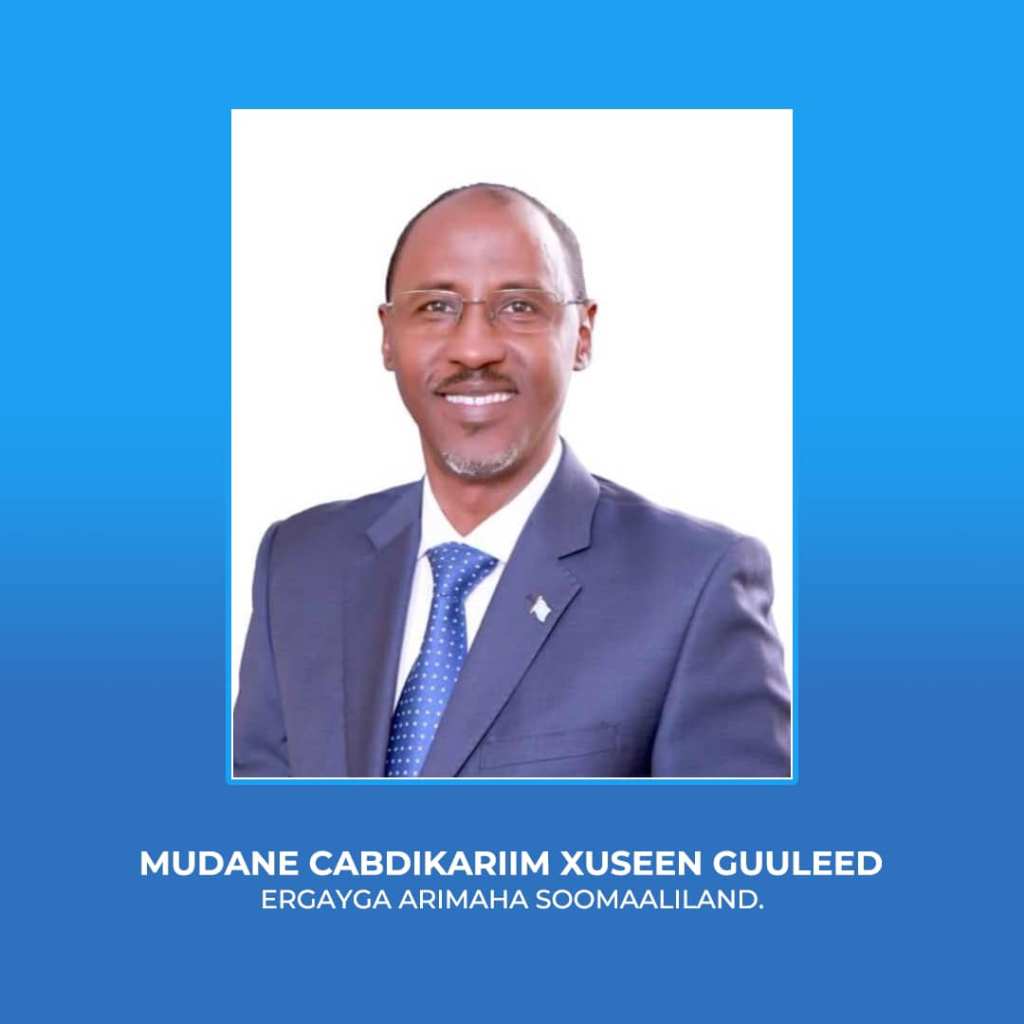
Mahmoud appointed close ally and former Galmudug State President, Abdikarim Guled as the Special Envoy, but why Abdikarim Guled?
Abdikarim Guled as Interior Minister
For almost two years between 2012 and 2014, Mr Guled served as the Federal Minister of Internal Affairs, having facilitated dialogue between the Somaliland regional separatist government led by Ahmed Mohamed Mohamud ‘Siilaanyo’ and the Transitional Federal Government of Somalia.
Guled led a delegation of senior Federal Ministers as well as Ministers that hailed from the SSC region to attend talks with a Somaliland delegation in Turkiye which ended in 2014.
Both sides agreed on a number of logistical and security issues, having reached agreements on economic and security cooperation such as the facilitation of the smooth transition of international resources from Mogadishu to Hargeisa as the latter is considered part of the Somali nation.
Ultimately, the talks drew to a close with a pledge by both sides to enter phase three of talks and plans for the creation of a joint committee to oversee this process that would be seated in Turkiye – none of which ever panned out.
Interestingly, while Abdikarim Guled informed media that the talks were heading in the positive directions and there were concessions from both sides, the then separatist Somaliland foreign minister, Mohamed Bihi Younis outlined that the secession of Somaliland was not up for discussion and would never be.
History of Talks between Separatist Somaliland and the Federal Government
The idea of talks between separatist Somaliland and the Somali Federal Government began during the 2012 London conference in which international stakeholders alongside the Somali Government discussed the future of the nation.
The subsequent communiqué released outlined that the conference recognised the need for the international community to support dialogue between the two sides to help move Somalia forward.
The first meeting between the two sides occurred in London. This was followed by a meeting between former President Sharif Sheikh Ahmed and former leader of Somaliland, Ahmed Mohamed Mohamud ‘Siilaanyo’ in Dubai. Finally, there would be a meeting between the newly elected President of the new Federal Government of Somalia, Hassan Sheikh Mahmoud and ‘Siilaanyo’ in Djibouti before delegations representing both sides met in Turkiye to further advance talks.
What has stalled talks in recent years?
During the Presidency of Farmaajo, talks did not kick off despite pledges made by President Farmaajo during his election campaign and tenure. The main reason for this stems from a number of previous issues and new ones that created further friction between the two sides. So let’s take a look at some of the issues on the table between the two sides:
- Somaliland highlights that in the previous talks, both sides agreed to share the airspace between them with Hargeisa given authority over the Somaliland region. However, upon the return of the control of Somali airspace to the country, the entirety of the responsibility was transferred to the Somali Civil Aviation Authority.
- Another major issue revolves around the Berbera Port agreement which was initially rejected by the Federal Government as bypassing all international political and legal frameworks because the UAE and Ethiopia signed agreements for the port with Somaliland without any consultation with Mogadishu – both Somali national law and international still considers Somaliland as de jure part of the Somali Federal Republic.
- Finally, separatist Somaliland leadership highlight the injustice committed in the Northern regions during the civil war and the lack of accountability for these war crimes.
What makes matters worse is that the Somali government has not been stable for the past few years with constant government changes, new ministers and new policies that are not in line with the previous administration, meaning a lack of consistency in the approach to the Somaliland conundrum.
For instance, 2021 saw the near capitulation of the Federal Government when militia loyal to the opposition attacked government forces in the capital.
Finally, the biggest elephant in the room remains the incomplete constitution.
The reality is that the federal constitution of Somalia is only provisional and is actually yet to be completed. The power-sharing dynamic within the Federal system remains ambiguous with resource allocation continuing to create friction between the current Federal government and Puntland State. The newly created Upper House has yet to have universally defined purpose.
These are just some of the constitutional issues within the current Federal system.
Greater issue of the ‘Social Contract’ & Trust in Government
The fact of the matter is that the issue of Somaliland is part of the greater issue in Somalia which is a lack of trust between the people of the nation and the government. Since the civil war that saw devastation and destruction, distrust and animosity, Somali clans have resorted to creating miniature states that represent clan interests which would eventually form the Federal system.
While talks regarding the particular issues raised by Somaliland ought to be rectify in these talks, other regions also have right to raise concerns about their own issues over the past three decades including South West State.
Ultimately, Somalia is attempting to create a universally accepted constitution and rebuild trust between its people and its own government. To do so, it must incorporate the entire nation on the issue of secessionism and the incorporation of Somaliland into the Federal system.
Current Laascaanood Conflict & Talks
The decision by the President, particularly during this period has created a political whirlwind in Somalia. Many have questioned why the President has decided to make such a move when the situation in Somaliland is worsening by the day.
Elections have been delayed since November 2022 with bloodshed seen when opposition parties attempted to rally support against an extension by the Bihi regime. The war in Laascaanood continues to intensify with over 200,000 people displaced and dozens killed or wounded including women and children despite the calls from Mogadishu and the international community to end the violence and for Somaliland to withdraw from the Sool region to enable talks.
The Bihi regime derailed the Addis Ababa talks following the declaration of a new offensive against the SSC-Khaatumo Council a week and a half ago which has resulted in more intense attacks by Somaliland as the desperation to capture the city grows in Hargeisa.
While Bihi has welcomed the new special envoy, many including Puntland State Government have highlighted that the decision could trample on the self-determination of the SSC-Khaatumo region which called on Villa Somalia to incorporate the region under its direct control which is yet to happen.
Somaliland considers the entirety of the SSC-Khaatumo region as part of its jurisdiction. Additionally, despite both the Federal Government in Mogadishu and the international community legally classifying Somaliland as part of Somalia, the region has acted as a de-facto separate state and will most likely place conditions on the talks including the need for Mogadishu to recognise the SSC region as part of Somaliland.
Reacting to the announcement, the SSC-Khaatumo Council welcomed talks to advance the unity of the nation however, the leadership made clear that it would not be part of any talks as it does not consider itself part of the separatist Somaliland agenda but rather the Federal Republic of Somalia.
Ultimately, many have highlighted that:
- HSM could have easily created a new Special Envoy for Sool to not only respond to the political request by the SSC-Khaatumo Council to increase FGS presence and control in the region but also help support the hundreds of thousands of civilians that have fled the conflict and are stranded in IDP camps in neighbouring Somali State and Puntland – many having no water or shelter.
Despite sending a clan delegation to Laascaanood, the delegation failed to meet Bihi and actually did not achieve any fruitful result with the SSC-Khaatumo Council clarify that it did not reach any ceasefire agreement with the delegation.
Indeed, it is evident that the Mahmoud administration has taken a somewhat weak and nonchalant stance on the conflict in Laascaanood and the underlining issue of Somali unity.
While Somalis will always welcome talks to rectify the issues between Somaliland and the rest of the country, the issue of SSC-Khaatumo must be rectified first before any talks can begin. That includes the recognition of the region by the Federal Government and withdrawal of all Somaliland forces from Sool.
For more on Somalia, follow Suldan Mohamed and HORUMAR.
 Horumar
Leave a comment