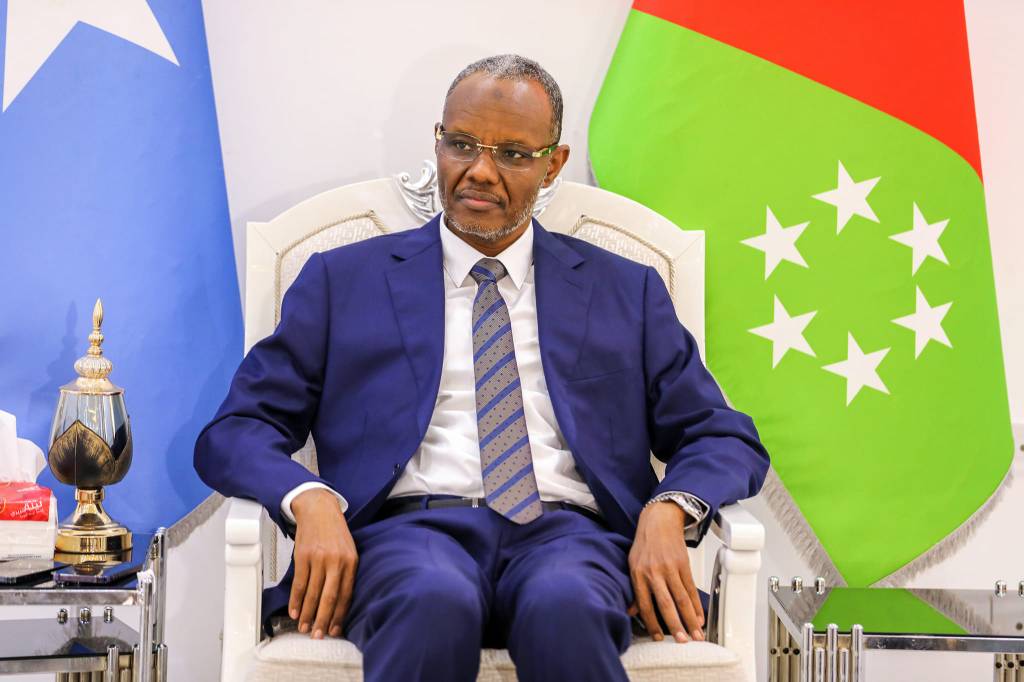
22.11.2023: Baydhabo, Bay
In a meeting held with South West State (SWS) parliamentarians in the transitional capital of Baydhabo, President Laftagareen emphasised the importance of the completion of the provisional constitution and the National Consultative Council Agreement during such a volatile political period. In certainty has loomed in recent weeks regarding the implementation of the NCC agreement as senior opposition figures and MPs have openly reject any changes to the constitution without public consultation and the inclusion of the Federal state of Puntland.
President Laftagareen emphasized that reshaping the country’s political system is a collective responsibility, highlighting the need for collaboration among different levels of government.
It was earlier this year when the National Consultative Council comprising of Federal Member State leaders (excluding Puntland), Federal leaders and the Governor of Banaadir region reached a political agreement that would see Somalia revert to back direct vote for officials starting next year for the first time in decades. The country had initially been scheduled to revert to universal suffrage in 2020 but protracted squabbles between the Farmaajo Administration and the Federal Member States’ of Puntland and Jubaland resulted in deadlock.
What are the Constitutional Changes?
In a statement in May, the Federal Government announced that the position of Prime Minister would be abolished and the entirety of the parliamentary system would be replaced by a presidential system in which the President and Vice President would be directly elected on a single ticket. Additionally, only two parties would be allowed to compete in initial polls.
The Federal Government also announced that nationwide local council elections, the first poll under the new system, will be held in June next year while voting for regional lawmakers will take place in November 2024, according to the statement.
Opposition & Absence of Puntland State
While major opposition figures such as former President Mohamed Abdullahi Farmaajo welcomed the reintroduction of direct elections for both state and federal levels of government, many have remained silent or outright reject any changes to the constitution.
Key former allies including former President Sharif Sheikh Ahmed and former Prime Ministers including Omar Sharmarke have rejected the removal of the Prime Minister Office and the introduction of a presidential system, highlighting that such a change would require the consent of all ‘political stakeholders’ as well as the state of Puntland which also outright reject the proposals – albeit rejection from Garowe stems from political tensions between state leader Said Deni and President Hassan Sheikh Mahmoud.
In a joint statement released in October, opposition leaders accused the President of “risking the unity of the nation”, highlighting that any such high-level constitutional changes could damage the clan distribution of power among Somali communities initially established in Djibouti 23 years ago.
“The current structure of government is an agreement entered into by the Somali people and it is important to have the participation of the entire Somali community through a constitutional process”, the statement read.
Submission of NCC Agreement to Parliament
The NCC agreement is expected to be submitted to Parliament for approval in the coming weeks, suggesting that the process is still undergoing formal legislative procedures. However, there has been major opposition to the agreement from numerous MPs that have publicly spoke about the drawbacks.
The opposition of Puntland MPs could be balanced by MPs from South West State during a parliamentary vote, given that MPs from other regions also vote in favour of the deal. Reports have emerged the President has asked his Ministers to encourage support amongst their clan constituencies for the deal.
For more on Somalia, follow Suldan Mohamed and HORUMAR on X.
 Horumar
Leave a comment