07.06.2025 — Mogadishu, Somalia
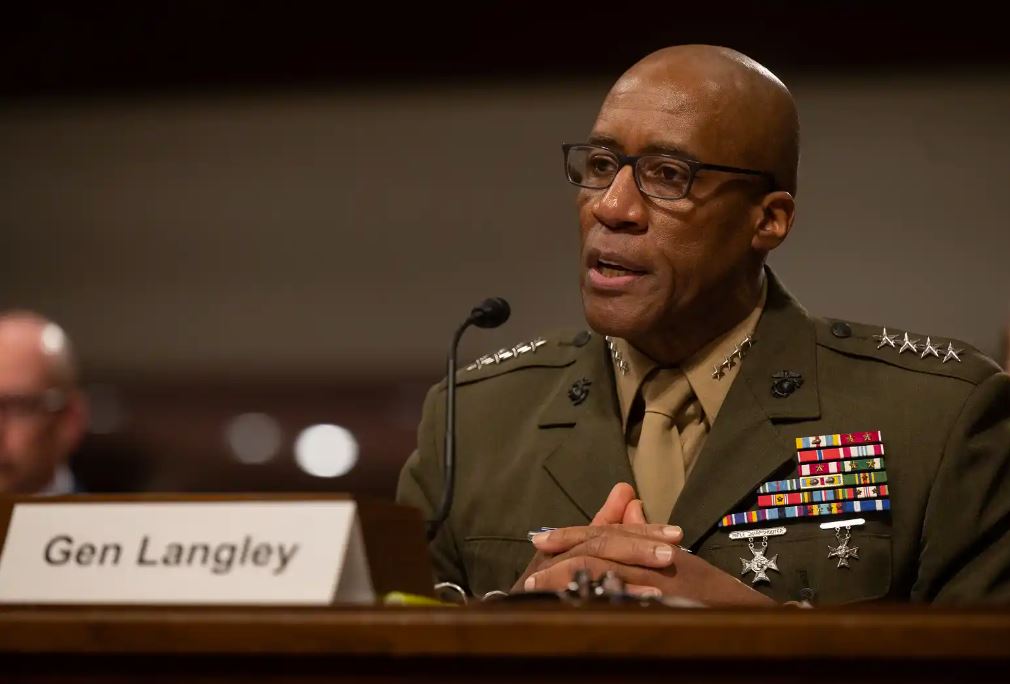
U.S. Africa Command (AFRICOM) Commander General Michael Langley has reaffirmed the United States’ strategic commitment to African security partnerships, but his recent remarks in Nairobi underscore a shifting posture – particularly regarding Somalia.
Speaking during a regional security forum in Kenya, Gen. Langley emphasized the need for “accountable, coordinated, and African-led security initiatives,” reiterating Washington’s concerns over inefficiencies and poor oversight in multilateral operations. His comments come as the African Union Support and Stabilization Mission in Somalia (AUSSOM) faces a deepening financial crisis that is rapidly undercutting its effectiveness.
Deepening Financial Crisis for AUSSOM
As of June, AUSSOM has only secured $16.7 million in funding, barely 18.5% of the $90.4 million required to cover its operational costs for the first half of 2025. Of this, $10 million comes from the African Union’s own Peace Fund, with modest pledges from China, Japan, and South Korea. The rest remains unfunded.
Adding to the strain is an inherited $93.9 million in arrears from the now-defunct ATMIS mission owed to frontline troop-contributing countries (TCCs) like Uganda, Kenya, Ethiopia, Djibouti, and Burundi. These outstanding payments are eroding morale and weakening commitment from key regional players.
The United States’ decision to withhold further financial backing, confirmed quietly earlier this year, has left a major gap in both morale and logistics. Washington cited concerns over lack of burden-sharing by other donors and a recent corruption scandal in Somalia involving the theft of rations from the elite Danab unit, which led to a broader cut in U.S. military support to the Somali National Army (SNA).
This funding reduction has already had visible consequences: Somali forces have lost key ground to al-Shabaab militants, particularly in Hirshabelle and Galmudug, where U.S.-backed support had once given the national army a tactical edge.
Danab’s Damaging Corruption Scandal
The Danab corruption scandal of 2024 exposed serious allegations of financial mismanagement and illicit profiteering within Somalia’s elite U.S.-trained special forces unit, Danab. Investigations revealed that senior officials within the Somali National Army and Ministry of Defence had allegedly diverted millions in military aid – meant for troop salaries, logistics, and equipment – into private accounts or ghost soldier schemes. The scandal caused significant embarrassment for both the Somali government and its international partners, particularly the United States, which had heavily invested in building the Danab as a reliable counterterrorism force. Public outcry intensified amid rising insecurity in parts of the country, with many citizens questioning the sustainability of foreign-backed military programs plagued by internal corruption. The government pledged to investigate and hold those responsible accountable, but skepticism remained high, given Somalia’s long-standing struggles with transparency and impunity.
DM Fiqi Sounds the Alarm: Security Gains at Risk Without Urgent Support
Defence Minister Ahmed Fiqi has urgently appealed to international partners, warning that without prompt and substantial support, the fragile gains against Al-Shabaab could be lost. The Intergovernmental Authority on Development (IGAD) has backed these concerns, urging deployment of an additional 8,000 peacekeepers and calling for a high-level donor summit. Yet, as things stand, no planning date has been set, and political momentum remains tenuous.
Compounding the crisis facing the current government is growing international fatigue. Many long-time partners are increasingly disillusioned with Somalia’s slow pace of reform, political infighting, and lack of tangible security or governance progress. Washington, under the isolationist leanings of the Trump administration, is aiming to pull back from direct engagement in Somalia shifting its focus to broader great-power competition. Meanwhile, the EU is preoccupied with the war in Ukraine and domestic political challenges, leaving Somalia largely sidelined on the European agenda. In this context, Somalia’s call for urgent support risks being drowned out by louder geopolitical crises elsewhere.
Reports are emerging that Villa Somalia is seeking support from Middle Eastern allies as President Hassan Sheikh spoke with the Qatari Emir, Sheikh Tamim ibn Hamad Al Thani this week. Unconfirmed sources indicate that Arab countries remain hesistant to bankroll the AUSSOM, especially as Western powers become dillusion with the Federal Government.
The United Arab Emirates emerged early on as President Hassan Sheikh Mohamud’s closest international ally, his first official visit abroad was to Abu Dhabi, signaling a clear intent to anchor Somalia’s external strategy around Emirati support. Villa Somalia appeared eager to leverage UAE financial channels to bankroll the military campaign against Al-Shabaab, especially as traditional donors in Europe began pulling back. However, cracks in the relationship are now emerging. Despite public gestures of solidarity, the UAE continues to back rival factions within Somalia, including Somaliland, Puntland, and Jubaland, undermining the federal government’s cohesion and authority.
This isn’t new. Villa Somalia seems to have overlooked the UAE’s broader regional track record marked by destabilising interventions in Sudan, Yemen, and Libya, as well as its shadowy role in illicit gold trading across Africa. What once seemed like a strategic partnership increasingly resembles a one-sided arrangement, with Somalia exposed to the risks of a foreign policy shaped by transactional ambition and geopolitical extortion.
Growing role of Türkiye in Somalia’s Defence Apparatus
Somalia’s defence ties with Türkiye are deepening and fast. This week, Ankara delivered additional Turkish-made T129 ATAK attack helicopters to Somalia’s air force, bolstering its counter‑insurgency capability beyond the Bayraktar drones already in use. These additions highlight Türkiye’s expanding military presence, from Camp TURKSOM training hundreds of Somali troops to recurring drone strikes coordinated with Ankara.
Yet, this shift has raised concerns in Washington. U.S. officials recently pressured Mogadishu to remove Defence Minister Abdulkadir Mohamed Nur, citing his aggressive alignment with Türkiye, as a condition for continued security cooperation.
Nur’s dismissal underscores growing American unease over Ankara’s rising influence, as Somalia’s defence apparatus tilts ever more toward Turkish support.
Al-Shabab Threats Continue: What Next?
The threat is far from theoretical. Al-Shabaab militants have struck with a surge of violence:
- As recently as 5 June, militants launched mortars at Mogadishu Airport’s Halane Base which houses international dignitaries.
- On 2 June, militants seized Hawadley village in Middle Shabelle and reportedly downed an AU helicopter, highlighting the rapid erosion of AUSSOM’s forward deployments.
- On 18 May 2025, a suicide bombing at a military recruitment centre in Mogadishu killed at least 21 people including new recruits and civilians, underscoring how the group is targeting the very heart of Somalia’s security forces
- On 24 April, militants launched a complex attack on a strategic SNA base in Wargaadhi. Although government forces repelled the attack, it demonstrates the growing security threats posed by al-Shabab.
- On 16 April, al-Shabab launched a coordinated attack on the strategic town of Adan Yabaal, seizing the area although it remains disputed.
- On March 18, al-Shabab launched an audacious attempt to assassination President Hassan Sheikh Mohamud.
- Between March 15-20, al-Shabab captured three strategic towns of Sabiid, Awdheegle and Sumadale.
- Between March 11 and 12, al-Shabaab gunmen attacked and besieged the Cairo Hotel in Beledweyne meeting venue for national officials resulting in at least 15 civilian deaths in a brutal 24‑hour siege.
The reality is that Al-Shabaab has become emboldened, buoyed by the perception that Villa Somalia is more preoccupied with political infighting than with prosecuting the war against terrorism. The decision to redeploy frontline troops to Ras Kambooni to confront Jubaland forces, rather than confronting the insurgency is a prime example and sends a dangerous signal: that the federal government’s priorities lie in settling political scores, not securing defeating al-Shabab.
With less than a year remaining in its mandate, the administration must shift course. It must make difficult but necessary concessions on the constitution and elections, forge agreements with Federal Member State leaders, and embrace compromise. Only then can the government, opposition and FMSs redirect all full focus toward confronting the growing threat posed by al-Shabaab and consolidating the critical gains made since 2022. If not, the militants will continue to exploit political paralysis, delivering strategic and potentially fatal blows both on the frontlines and within Mogadishu itself.
 Horumar
Leave a comment