Written by Suldan Mohamed
Throughout the 20th century, Arab nationalism emerged as a powerful, if ultimately fractured, force that sought to unify the Arab world and reclaim sovereignty from colonial powers. For the Somali people, that have long grappled with questions of unity, identity, sovereignty, and the influence of external powers, Arab nationalism offers both inspiration and cautionary lessons.
The Roots of Arab Nationalism: Under Ottoman Rule
The seeds of Arab nationalism were sown during the long period of Ottoman rule in the Arab provinces. While the Ottoman Empire had governed much of the Arab world since the 16th century, the relationship between the Arab subjects and the central Ottoman authority began to change in the 19th and early 20th centuries. The Tanzimat reforms (1839–1876), aimed at modernising the empire, also centralised authority and promoted Ottomanism as a unifying identity. However, these reforms often came at the expense of local autonomy, destroying local identity and provoking resistance among Arab elites.
By the late 19th century, Arab intellectuals and reformers in cities like Damascus, Beirut, and Cairo began to develop a sense of distinct Arab identity. Influenced by the European Enlightenment and nationalism, they promoted the Arabic language, revived Arab history and literature, and advocated for greater Arab participation in governance. Publications, literary societies, and schools played a crucial role in fostering this cultural renaissance. This was known as the Nahda and laid the intellectual groundwork for political Arab nationalism.
The rise of the Committee of Union and Progress (CUP) and its emphasis on Turkish nationalism further alienated many Arab officers and bureaucrats in the Ottoman empire during this period. The CUP was a reformist political movement that evolved into a Turkish nationalist ruling party after 1908, promoting centralisation, secular modernisation, and the primacy of Turkish identity within the multi-ethnic Ottoman Empire. Secret societies such as al-Fatat and the Arab Revolt Society emerged, demanding greater Arab autonomy or outright independence. Early Arab nationalism was thus both a cultural movement and a political reaction to Ottoman centralisation and Turkification policies.
The Arab Revolt and Hussein ibn Ali’s Miscalculation
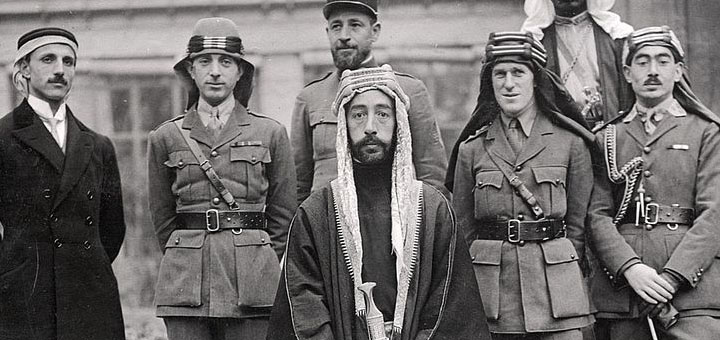
The most dramatic manifestation of early Arab nationalism was the Arab Revolt (1916–1918), led by Sharif Hussein ibn Ali of Mecca. Hussein, the Sharif of Mecca and head of the Hashemite family, entered into correspondence with British High Commissioner Henry McMahon. In the Hussein-McMahon Letters (1915–1916), the British promised to support Arab independence across a broad region from Aleppo to Aden, in exchange for launching a revolt against the Ottomans. Crucially, the borders discussed were vague, and Palestine was not explicitly included or excluded.
Hussein envisioned himself as the leader of a unified Arab kingdom, but he failed to anticipate the duplicity of the British, who had already entered into the secret Sykes-Picot Agreement (1916) with France to divide Ottoman Arab lands into zones of influence, and the Balfour Declaration (1917), which promised support for a Jewish homeland in Palestine.
Some Arab critics view the Arab Revolt as a betrayal of the Arab cause, arguing that Hussein’s cooperation with the British indirectly enabled Western domination and the loss of Palestine. Detractors accuse him of naivety or opportunism, charging that he placed dynastic ambitions above pan-Arab unity. Although his sons were installed as monarchs in Iraq and Transjordan – client states of the British – real power lay with colonial administrators, and the broader vision of Arab independence was never realised.
British Patronage and the Rise of Gulf Monarchies
While nationalist aspirations flourished in the Levant and North Africa, the Arabian Peninsula followed a different trajectory. Britain, seeking to secure maritime routes and oil interests, established protectorate relationships with various tribal sheikhdoms along the Gulf coast throughout the 19th and early 20th centuries. Through a series of treaties, Britain gained control over the foreign affairs and defense of territories such as Kuwait (1899), Bahrain (1861), Qatar (1916), and the Trucial States (now the UAE, under treaties beginning in 1820 and culminating in a formal protectorate in 1892).
These monarchies were not the product of mass nationalist movements, but of British strategic planning and tribal politics. The British relied on established dynasties such as the Al Sabah in Kuwait, the Al Khalifa in Bahrain, and the Al Thani in Qatar. This was to maintain stability and protect imperial interests. Oil concessions in the early 20th century only deepened British involvement, as these states became increasingly important to Western energy security.
Saudi Arabia followed a different yet related path. The House of Saud, in alliance with the puritanical Wahhabi movement, managed to unify much of the Arabian Peninsula through a series of military campaigns, culminating in the establishment of the Kingdom of Saudi Arabia in 1932. While technically independent, the kingdom also maintained a close relationship with Britain and later the United States due to its oil wealth and strategic location in exchange for access to political and military support. A theme seen in the Middle East today.
Mid-20th Century Arab Nationalism: Ba’athism and Nasserism
Following World War II, a new wave of Arab nationalism emerged driven by a younger generation disillusioned with monarchies and colonial arrangements. These movements embraced anti-imperialism, pan-Arab unity, and socialism. The Free Officers coup in Egypt in 1952 brought Gamal Abdel Nasser to power. Nasser a charismatic leader who quickly became the face of Arab nationalism. He was a famous name in Somalia and the face anti-imperalism in the 1960s.
Nasser’s nationalisation of the Suez Canal in 1956 and his defiance of Britain, France, and Israel during the Suez Crisis made him a hero across the Arab world. He advocated for the creation of a unified Arab state and promoted Arab socialism as a means to end poverty, corruption, and Western dependency. Nasserism inspired coups and revolutions across the region, including in Iraq (1958), Syria (1963), and Libya (1969).
Parallel to Nasserism was the rise of Ba’athism, a pan-Arab socialist ideology founded by Michel Aflaq and Salah al-Din al-Bitar. Ba’ath parties gained power in Syria and Iraq, though ideological differences and power struggles eventually led to divergence. The formation of the United Arab Republic (UAR) in 1958 following the unification of Egypt and Syria was the high point of Arab nationalist ambition, but its dissolution just three years later exposed deep political and structural challenges.
Despite early successes, Arab nationalism struggled with internal authoritarianism, sectarian divides, and economic underperformance. The crushing defeat in the 1967 Six-Day War with Israel dealt a severe blow to its credibility. In the ensuing decades, Arab nationalism gave way to local nationalisms, political Islam, and regime survivalism. The role of Western powers influencing regimes was significant during this period primarily due to the Cold War and concerns of Soviet influence. Events in neighbouring Iran in 1953 by the Iranian Monarchy supported by the US and UK or the Saur Coup of 1978 in Afghanistan by the People’s Democratic Party of Afghanistan supported by the Soviet Union demonstrated the extent of global influence in the region.
The Partition of Palestine and Ongoing Fragmentation
Central to the Arab nationalist narrative is the tragedy of Palestine. The Balfour Declaration (1917) and the subsequent British Mandate in Palestine paved the way for the establishment of Israel in 1948. The expulsion of hundreds of thousands of Palestinians during the Nakba and the failure of Arab armies to prevent the loss of territory fueled resentment and radicalisation.
The 1967 war, in which Israel captured the West Bank, Gaza, East Jerusalem, and the Golan Heights, further fragmented the Arab world. Some states, like Jordan and Egypt, eventually made peace with Israel, while others maintained rhetorical support without concrete action. Divisions deepened in the wake of the Oslo Accords and, more recently, the Abraham Accords, which saw several Gulf states normalise relations with Israel.
Today, the Arab world remains fractured, divided by civil wars, regional rivalries, sectarianism, and external influence. The hopes of unity and sovereignty espoused by Arab nationalism have largely faded, replaced by pragmatic alignments and national self-interest. This is largely due to gulf states such as the UAE supporting the fragmentation of any state that even appears to support Arab unity. Two examples are the toppling of Egyptian President, Mohamed Morsi by General al-Sisi or the ongoing war in Sudan with the support of the Rapid Support Forces (RSF). Ultimately, there is a fear amongst Arab monarchies that the ideas of Islamic political movements and nationalist sentiment would create an uprising in their countries, especially after the events of Arab Spring in 2011.
Somaliland and the Argument for Somali Fragmentation
One argument often made by separatist Somaliland supporters is that the Arab world contains numerous sovereign Arab states, each with its own identity, borders, and institutions despite sharing a common language and cultural foundation. If the Arab world can consist of over twenty independent states, the argument goes, then the Somali-speaking world can likewise accommodate multiple sovereign entities.
However, the comparison is more complex and misleading. The Arab world was not voluntarily fragmented but was divided by colonial powers through arbitrary borders, protectorates, and mandates. The Sykes-Picot Agreement, the Balfour Declaration, and British-French colonial policies intentionally prevented Arab unity. The modern borders of the Middle East were drawn with little regard for ethnic, tribal, or religious cohesion.
North African states like Algeria, Tunisia, and Morocco have different historical trajectories from Gulf monarchies such as Saudi Arabia and Qatar. The former were shaped by settler colonialism and mass nationalist resistance; the latter by British diplomacy and dynastic consolidation. The Arab world’s fragmentation is thus not a model to emulate but a historical wound that continues to generate conflict.
Somalia, unlike the Arab world, began as a unified postcolonial state. Its current fragmentation is marked by the emergence of Somaliland, federal member states, and contested regions which mirrors the pitfalls of weak institutions, unresolved grievances, and external interference. If anything, the Arab experience warns against the long-term instability and loss of agency that can follow disunity.
Today, the idea of Arab nationalism or unity is a long forgotten thought.
Lessons for Somalis
For Somalis, the history of Arab nationalism offers important lessons:
- Unity Must Be Homegrown: Arab nationalism was often top-down, driven by elites and leaders who failed to build inclusive grassroots support. Somali unity must be rooted in shared purpose, inclusive politics, and national reconciliation.
- Beware of External Promises: Like Hussein ibn Ali, Somalis have too often placed hope in foreign actors. True sovereignty requires strategic engagement, not dependency.
- Institutional Strength Over Rhetoric: Arab regimes often emphasised slogans over institution-building. Somalia’s future depends on strong institutions, not merely nationalist sentiment and remarks.
- Don’t Repeat the Mistakes of Fragmentation: The Arab world fractured due to competing interests, external interference, and lack of collective foresight. Somalia, too, risks permanent fragmentation if political reconciliation and inclusive governance are not prioritised.
- Balance Identity with Pragmatism: Arab nationalists often over-relied on identity at the expense of economic and administrative development. Somali nationalism must be pragmatic, balancing cultural pride with state-building.
Conclusion
The story of Arab nationalism is one of ambition, betrayal, resilience, and fragmentation. For Somalis, it offers a cautionary tale: unity and sovereignty are not guaranteed by sentiment or external alliances, but by institution-building, inclusive governance, and strategic autonomy. Arab nationalism may not have fulfilled its dreams, but its rise and fall provide a mirror for Somalis striving to avoid similar pitfalls while charting a national path forward.
 Horumar
Leave a comment